
When you are managing a pig farm, the corn silo isn’t just a storage tank; it’s the heart of your feeding efficiency. For silos in the 1 to 5-ton range, accuracy isn’t just a luxury—it’s the difference between profit and waste. Many farms have struggled with sensor failures or inconsistent readings. They often treated silo weighing as a simple “plug and play” task.
If you’re using top-notch modules like the FWC (Stainless Steel) or FW (Alloy Steel), you have the right tools. The success of a 5-ton corn weighing system relies on how you manage the farm environment. Here is a breakdown of the key factors that matter on the ground.
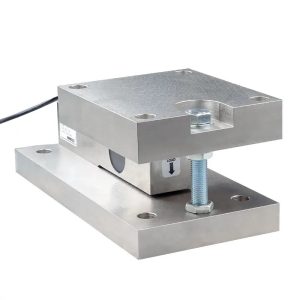 FW Cantilever Beam Weighing Module (0.5t–10t) for Suspended Hoppers
1. Choosing the Right Tool: FWC vs. FW
For a 1-5 ton silo, your choice of module material is your first line of defense.
-
The FW Module: This is usually nickel-plated alloy steel. It’s a workhorse—rugged and cost-effective. In a standard dry storage shed, it performs beautifully.
-
The FWC Module: This is the stainless steel version. If your silo is outside or close to pig pen cleaning areas with high humidity and ammonia, don’t take shortcuts. Go for the FWC. Corrosion is the silent killer of load cell accuracy, and stainless steel pays for itself in avoided replacements.
2. The 3-Point vs. 4-Point Support Logic
For small to medium silos (under 5 tons), I always get asked: “Do I need three modules or four?”
-
The 3-Point Setup: This is a geometric ideal. Like a camera tripod, three points will always find their level. It’s cost-effective and simplifies the wiring.
-
**The 4-Point Setup:** If your silo is tall and narrow or exposed to strong winds, using four points stabilizes it better. Pro Tip: If you use four points, ensure your foundation is perfectly flat. If one leg is even a few millimeters “shorter,” that module will sit idle, and your total weight reading will be erratic.
3. Dealing with the “Corn Factor”
Corn is a living, breathing material in terms of weight distribution. Unlike water, corn creates “bridging” and uneven friction against the silo walls.
-
Side Loading: As corn settles or flows out, it doesn’t always drop straight down. It can push sideways. Modules like the FW/FWC are crucial. They can handle some horizontal movement without harming the load cell.
-
Vibration: Most corn silos use vibrators or augers to prevent clogging. These vibrations can “noise up” your weight signal. Make sure your weighing controller has a good digital filter. This will smooth out spikes. Otherwise, your feed inventory could jump by 50kg each time the motor starts.
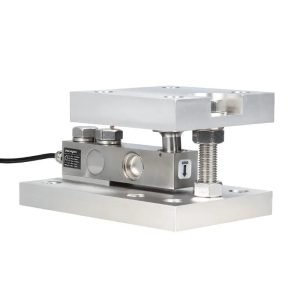
FWC Explosion-Proof Cantilever Beam Weighing Module
4. The Critical Role of Flexible Connections
This is the #1 mistake I see in the field. If you bolt a rigid steel pipe to a silo sitting on load cells, the pipe acts as a “spring.” It will support part of the weight, and your readings will be useless.
-
Rule of Thumb: Every inlet and outlet pipe must have a flexible canvas or rubber sleeve.
-
Wiring: Even the electrical conduit should have a loop of slack. A stiff wire can pull on a 1-ton silo enough to throw off the accuracy by several kilograms.
5. Environmental Hardening in Pig Farms
Pig farms are tough on electronics. Between the dust from the corn and the wash-downs, your modules need to be “armored.”
-
Junction Boxes: Always use a stainless steel junction box with a high IP rating (IP67 or higher). Use desiccant pouches inside the box to absorb any trapped moisture.
-
Grounding: Lightning loves a tall outdoor silo. Make sure your system has a proper bypass ground cable. This copper strap should connect the top plate to the bottom plate of the load cell module. This way, any surge will go to the earth instead of the sensitive strain gauge.
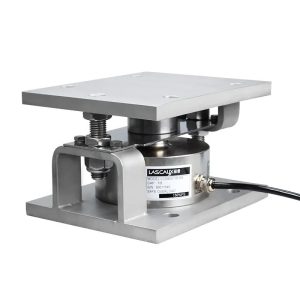
GL Batching Weighing Module for Hopper, Tank and Silo Systems
6. Calibration: The Reality Check
You’ve installed your 3 or 5-ton system—now how do you know it’s right? You likely won’t have 5 tons of certified test weights stored on the farm.
-
The Substitution Method: Start with a known weight (even a few 25kg bags of feed). Note the reading. Then fill the silo with corn, note the increase, and add the known weight again. Although it’s a tedious process, a pig farm finds it the most practical way to ensure that real numbers support your feed conversion ratios.
7. Why Accuracy Saves Money
Let’s talk numbers. In a 5-ton silo, a 1% error is 50kg of feed. Over a year of multiple refills, that’s tons of corn unaccounted for. The FWC/FW modules offer clear visibility. You can track your supplier’s delivery or calculate feed intake per pig with minimal effort. You’ll know when the truck is short-changing you. You’ll also see when your pigs stop eating, which is often the first sign of illness.
When you set up your FW or FWC modules, take ten extra minutes to check the top and bottom plates. They must be level. Use a spirit level. If you tilt the module, the force vector skews, and the load cell won’t “see” the full weight.
Precision in livestock management starts with the ingredients. Caring for your corn silo is key. Use flexible joints, ensure strong grounding, and choose the right materials. This way, your silo becomes a valuable management tool.