
If you build or source automatic checkweighers, you learn pretty quickly that the weighing sensor has a bigger impact on machine performance than most people expect.
A fast conveyor and a reliable reject system look great in a brochure, but if the load cell cannot produce stable readings at production speed, the problems show up fast. Unnecessary rejects start increasing. Weight consistency becomes harder to control. Operators end up making constant adjustments just to keep the line running smoothly.
That is the reality of dynamic weighing.
And for compact, high-speed machines, choosing the right checkweigher load cell is one of the decisions that matters most.
For many OEM manufacturers, the aluminum double ended shear beam load cell remains a practical choice—not because it fits every application, but because it performs well in the environments these machines are actually built for.
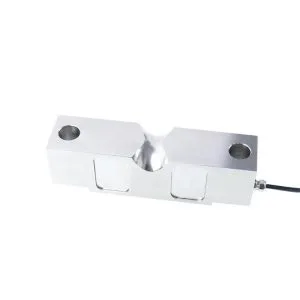
DSC Double ended shear beam load cells for tank scales
Dynamic Weighing Is a Different Engineering Problem
Static weighing is simple.
The product sits still. The sensor has time to settle. External disturbances are limited.
An automatic checkweigher works under completely different conditions.
Products arrive continuously, often with only minimal spacing between them. Conveyor transfers introduce vibration. Lightweight packs may shift or bounce slightly as they move onto the weigh belt. Some products land perfectly centered; many do not.
And the weighing system still has to capture an accurate reading in a very short time window.
On a fast snack packaging line, speeds of 150 to 300 products per minute are not unusual. In pharmaceutical packaging or compact personal care lines, similar throughput is common.
At that pace, sensor response speed becomes a real engineering issue, not just a specification sheet detail.
Why Aluminum Performs Well in This Environment
One of the reasons aluminum works so well in dynamic weighing applications is straightforward: less mass means faster response.
In a high-speed packaging weighing system, the sensor assembly has only milliseconds to react to a changing load, stabilize the signal, and pass usable data to the controller.
A heavier weighing structure naturally reacts more slowly.
A lighter one improves responsiveness.
That is especially relevant when weighing small packaged products like snack pouches, stick packs, blister cartons, sachets, or lightweight flow-wrapped items. These products move quickly, and the weighing window is extremely short.
Lower moving mass can also improve system natural frequency, which is one of the reasons aluminum-based dynamic weighing sensors are commonly used in compact high-speed equipment.
For OEM checkweigher manufacturers trying to balance speed and accuracy, that mechanical advantage is hard to ignore.
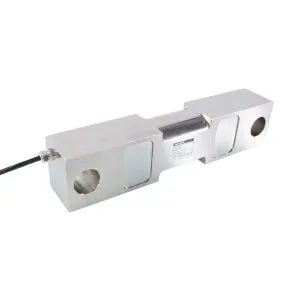
DST Double ended shear beam load cells for hopper Scales
Why the Double Ended Shear Beam Design Helps
Material selection is only part of the equation.
Sensor design plays an equally important role.
A double ended shear beam configuration offers practical benefits in high-speed weighing environments because it provides stable mechanical support from both ends. That helps distribute force more evenly across the weighing platform, which improves consistency when products are not perfectly positioned.
And in real production, perfect positioning is more the exception than the rule.
A product may enter slightly off-center. A pouch may twist during conveyor transfer. A lightweight carton may land with a minor shift in alignment.
A weighing system has to tolerate those variations without losing stability.
That is one reason the aluminum double ended shear beam load cell works well as a dynamic weighing sensor in compact automatic checkweighers.
The shear beam structure also tends to perform reliably in environments where vibration and moving mechanical forces are unavoidable—which describes almost every real packaging line.
Why OEM Builders Often Prefer This Approach
Machine builders are constantly balancing competing demands.
End users want smaller machines that fit into crowded production spaces.
Engineering teams need consistent weighing performance.
Purchasing teams want commercially competitive designs.
This is where aluminum often makes practical sense.
Because the material reduces overall structural weight, it helps simplify integration into compact packaging machinery without sacrificing the stability needed for dynamic weighing.
That matters in equipment such as horizontal flow wrappers, vertical form fill seal systems, pouch packaging machines, blister packaging lines, and other compact packaging automation systems.
For an OEM checkweigher manufacturer, the goal is not simply accurate weighing. The machine also has to be compact, commercially viable, and easy to integrate into real production lines.
The right load cell helps support all three.
DSE Double ended shear beam load cells for silo scales
Where This Type of Load Cell Is Commonly Used
Small high-speed automatic checkweighers are typically used for lightweight packaged products moving through controlled indoor production environments.
Food packaging is one of the most common examples.
Snack foods, confectionery, frozen convenience products, instant noodles, and small pouch-based packaging often require fast dynamic inspection without heavy load requirements.
Pharmaceutical packaging is another strong fit. Products such as blister cartons, supplement bottles, medicine boxes, and healthcare packaging need reliable weight verification, often at relatively high throughput.
Cosmetics and personal care applications are similar. Shampoo bottles, skincare products, soap cartons, and small personal care kits often move through compact packaging lines where both speed and machine footprint matter.
Consumer electronics packaging can also be a suitable application, particularly for lightweight accessory kits or small retail products.
Across all of these sectors, the performance requirements are similar: fast response, stable measurement, and compact integration.
Engineering Reality: Cost Is Part of the Decision
No serious equipment manufacturer makes engineering decisions based only on ideal technical performance.
Commercial reality matters too.
Stainless steel load cells are absolutely the right solution in some applications, especially where aggressive washdown, chemical exposure, or harsh environmental conditions are involved.
But many automatic checkweighers operate in relatively clean indoor packaging environments where those protections are not necessary.
In that context, using stainless steel simply because it sounds more robust can add cost without delivering meaningful operational benefit.
That is where the aluminum double ended shear beam load cell often becomes the more practical choice.
It gives OEM builders the performance needed for compact dynamic weighing applications without the higher material cost associated with heavier alternatives.
Good engineering is not about choosing the most expensive option.
It is about choosing the right one.
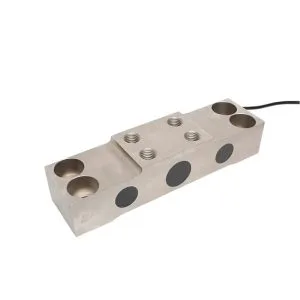
607A 30t Double Ended Shear Beam Load Cell
Where Aluminum Is Not the Right Fit
Application matching still matters.
This type of load cell is not ideal for every operating condition.
Heavy washdown food processing environments are an obvious example. Fresh meat, seafood, poultry, and dairy production typically require stronger corrosion resistance and more aggressive environmental protection.
Heavy logistics systems are another case. Large parcel checkweighers and industrial transport inspection systems place very different mechanical demands on the sensor.
Chemical processing environments may also be unsuitable depending on exposure conditions.
And for pallet weighing or other heavy industrial applications, aluminum is generally the wrong material choice.
That is not a limitation unique to this design. It is simply part of selecting the correct technology for the job.
What Buyers Should Actually Ask
Capacity and price are easy to compare.
Real-world performance is more important.
For high-speed checkweigher applications, better questions include:
How stable is the signal under continuous vibration?
How quickly does the sensor respond?
How tolerant is the design to minor off-center loading?
How easily does it integrate into the machine structure?
What kind of long-term stability can be expected in continuous production use?
Can the supplier support OEM integration requirements?
These are the questions that determine whether a load cell performs well outside the catalog.
For small high-speed automatic checkweighers, the best load cell is not necessarily the heaviest or the most expensive.
It is the one that matches the application.
For lightweight packaged products moving quickly through controlled production environments, the aluminum double ended shear beam load cell remains a highly practical checkweigher load cell solution.
It offers the combination most OEM builders actually care about: responsive dynamic weighing performance, stable measurement, compact integration, and sensible cost.
For many packaging equipment manufacturers, that is simply a practical engineering decision.