
In many mid-sized cement plants, forklifts do far more than simply move goods from one place to another.
They carry powdered additives from storage to the production line. They transport bagged cement to loading zones. They move recycled material, spare parts, pallets, and bulk supplies throughout the workshop. On a normal production day, the same forklift may complete dozens of handling tasks before the shift ends.
The machine is everywhere.
In many cement factories that make 50,000 to 70,000 tons a year, one problem holds up production: weighing happens separately.
The forklift moves the load. Weight confirmation happens later. It uses a floor scale, a platform scale, or another fixed weighing station. This might look easy, but in real conditions, it causes small delays that many factories overlook.
A pallet is picked up.
It is moved to a weighing point.
The operator waits for a stable reading.
If the quantity is not correct, the load is adjusted.
Only then does the forklift continue to the next destination.
This means the same material is often handled more than once before it reaches where it needs to go.
In a dusty, high-frequency cement environment, those extra steps cost both time and labor.
That is why more plant managers are now turning to the forklift weighing system as a more practical solution.
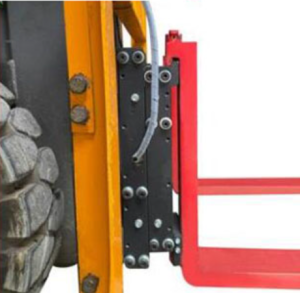
A forklift scale merges transport and weighing into one smooth action. The forklift lifts, weighs, transports, and records the load during normal handling. There is no need to stop at an additional scale station unless required.
It sounds like a simple change.
On the production floor, however, it makes a measurable difference.
The Hidden Cost in Cement Plants Is Often Not Transportation — It Is Unverified Weight
Most forklifts in cement plants appear to be working efficiently enough.
Materials are moving.
The production line is supplied.
Warehouse shipments go out.
Nothing seems obviously wrong.
But when monthly inventory reports begin to show inconsistencies, management usually starts noticing a familiar pattern.
Raw material consumption does not fully match planned usage.
Outbound loading records contain small but repeated quantity deviations.
Warehouse stock figures drift from physical counts.
Manual corrections appear too often in internal reports.
These issues are rarely caused by one major loading mistake. More often, they come from small weight uncertainties repeated every day.
An additive batch is loaded by estimate.
A pallet is transferred without exact net verification.
A forklift operator relies on visual judgment.
A dusty floor scale delivers readings that are slightly off calibration.
None of these look serious on a single trip. Across dozens of transfers every shift, they become a real material loss.
This is where a forklift weighing system changes the entire handling logic.
Every load is weighed while being transported.
The operator sees the exact figure before unloading.
The warehouse receives a confirmed quantity instead of an approximation.
Production supervisors can compare actual transfer volume with planned material usage much more accurately.
In other words, the forklift stops being just a transport vehicle.
It becomes a mobile weighing checkpoint that follows the material through the plant.
And once weight verification moves into the handling process itself, a large amount of invisible loss becomes easier to control.
Why Traditional Floor Scales Often Struggle in Cement Workshops
Cement plants are among the harshest working environments for weighing equipment.
Dust never truly leaves the floor.
Fine powder settles into corners, around sensor gaps, below scale platforms, and across display panels. Over time it affects reading stability, cleaning frequency, and even operator visibility. Add constant forklift vibration, occasional impact, and moisture mixed with alkaline particles, and fixed weighing stations begin to require far more maintenance than expected.
This is one reason many factories eventually stop trusting ordinary static scales for frequent internal handling.
The scale may still function, but not always with the consistency daily production needs.
A forklift weighing scale avoids much of this problem because the weighing point is no longer concentrated in one exposed floor location.
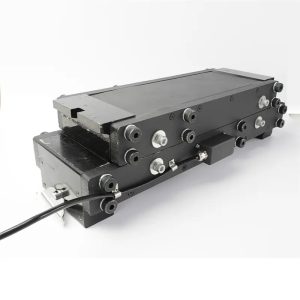
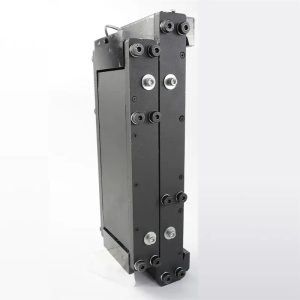
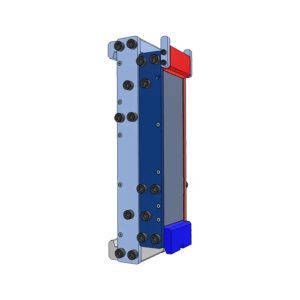
Modern forklift weighing systems use enclosed load sensors or hydraulic pressure measurement modules installed directly within the lifting structure. Industrial models are designed with anti-dust sealing, reinforced sensor protection, and vibration resistance specifically for heavy workshop conditions.
That means the forklift can weigh the material exactly where the work is already happening.
There is no need to repeatedly drag dusty pallets onto a fixed platform.
There is no single scale zone collecting powder and forklift impact all day.
And there are fewer interruptions caused by cleaning or recalibration.
For cement manufacturers, this is not a minor technical detail.
A weighing device that performs well in a clean warehouse may not survive long under continuous powder exposure. Reliability on paper and reliability on the workshop floor are often two very different things.
This is why durability, dust resistance, and long-term weighing stability matter just as much as accuracy itself when choosing an industrial forklift scale.
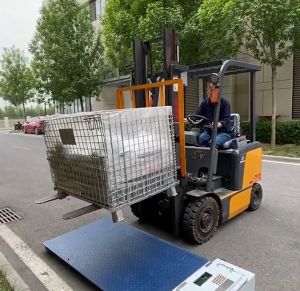
Forklift Weighing Systems Improve Handling Efficiency in a More Direct Way
When factories discuss improving forklift productivity, the first instinct is often to look at speed, battery life, or lifting capacity.
Those factors matter.
But one of the biggest hidden delays in material handling is unnecessary repetition.
A forklift collects the load.
Stops at the weighing station.
Waits.
Reads.
Adjusts.
Moves again.
This stop-weigh-move routine seems harmless when viewed once. Repeated one hundred times a day, it quietly consumes a large amount of productive machine time.
An onboard forklift weighing system removes that interruption.
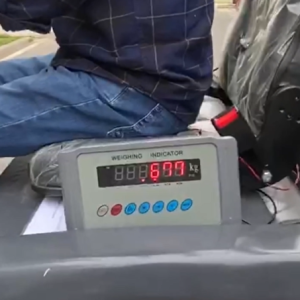
The operator lifts the goods and sees the weight immediately on the display. If the target quantity is correct, transport continues straight to the destination. If the payload needs adjustment, that can be handled instantly before the next process step begins.
There is no extra detour.
No queue in front of a platform scale.
No second alignment.
No additional worker required to record readings manually.
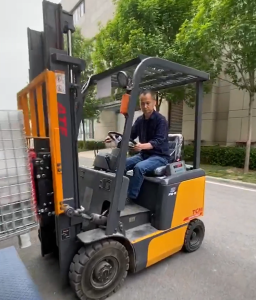
As a result, the entire handling cycle becomes shorter without increasing operator speed.
This usually translates into several practical gains:
-
more pallet transfers completed per shift,
-
faster additive feeding into production,
-
quicker outbound loading preparation,
-
less waiting time in narrow warehouse passages.
For medium-output cement factories operating under controlled equipment budgets, this matters a great deal.
Increasing throughput without buying another forklift is often one of the most cost-effective improvements a plant can make.
And that is exactly why many managers see forklift weighing scales as an efficiency investment rather than just a weighing accessory.
Better Material Flow Also Means a Cleaner and Safer Workshop
One operational issue that factories often overlook is what happens around central weighing points.
Because all loads need to pass through the same scale station, forklifts tend to cluster in one area. Waiting pallets, manual records, loose packaging debris, and accumulated powder begin to build up around the same traffic route.
This creates congestion.
Turning space becomes tighter.
Operator visibility drops.
Human contact around moving forklifts increases.
In busy cement workshops, that bottleneck becomes both a productivity issue and a safety concern.
Once each forklift carries its own weighing capability, material movement becomes more direct.
Operators no longer need to pause at the same floor point for every transfer.
Routes stay cleaner.
Traffic disperses more evenly.
Handling becomes more linear from pickup to unloading.
This kind of improvement does not always show up immediately in production spreadsheets, but supervisors notice it quickly on the workshop floor because the entire area feels less crowded and less chaotic.
Sometimes operational discipline improves simply because the traffic path stops fighting itself.
Real-Time Weight Data Gives Management Better Inventory Control
Another reason forklift weighing systems are becoming more attractive is the shift toward digital weight recording.
Many medium-sized cement plants still depend partly on handwritten notes or delayed warehouse entries after material movement has already happened. By the time quantity discrepancies are discovered, tracing the source becomes difficult.
A modern forklift scale system can connect with onboard printers, wireless transmission modules, warehouse ERP software, or internal production management systems.
This means every handling movement can produce a traceable weight record in real time.
Management no longer needs to guess where quantity drift occurred.
They can check:
How much gypsum was moved today?
How many tons of bagged cement were loaded this morning?
Was additive transfer volume consistent with production demand?
Which forklift completed a certain outbound shipment?
This level of visibility gives managers faster answers and tighter inventory discipline.
For companies trying to reduce waste, improve warehouse accuracy, and avoid expanding office labor, onboard weighing data becomes a practical management tool rather than just another machine feature.
A Smarter Long-Term Fit for Mid-Sized Cement Manufacturers
Not every factory upgrade needs to involve a major automation overhaul.
Sometimes the most effective improvements come from upgrading the equipment that already performs the highest number of daily tasks.
Forklifts are already central to internal cement logistics.
Adding an industrial forklift weighing system simply allows each movement to do more than transportation alone.
It adds confirmation.
It adds measurable control.
It adds data.
And it removes much of the inefficiency created by separate static weighing stations.
For cement plants producing 50,000 to 70,000 tons per year, the value is easy to see:
-
durable weighing performance in dusty environments,
-
higher handling efficiency with fewer repeated movements,
-
better material verification during transfer,
-
improved warehouse traceability and inventory discipline.
In short, a forklift weighing system is no longer just an optional attachment.
For many cement manufacturers, it is becoming part of a more reliable material handling process.
Because once forklifts are able to transport and weigh at the same time, returning to the old stop-and-weigh routine starts to feel unnecessarily slow, unnecessarily labor-heavy, and unnecessarily uncertain.