
Single point load cell may go unnoticed, but it plays a key role in everyday weighing systems. If you’ve used a retail scale, a supermarket scale, or a lab scale, you likely used a single point load cell. This sensor stands out for its simplicity. It can measure force accurately from one spot. It remains consistent across the entire platform.
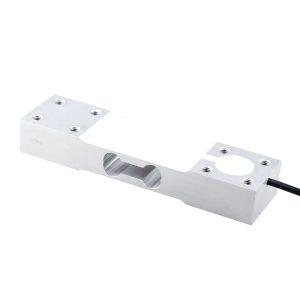
LC1540 Aluminum Alloy Single Point Load Cell for Medical Scale
Understanding the Single Point Load Cell
Engineers create a single point load cell. This device measures weight anywhere on a platform, not just at one spot. This sets it apart from other load cells, like shear beam or compression types. Those usually need more exact load placement.
In a platform scale, the load cell is usually mounted beneath the center of the weighing plate. Its design ensures that the load cell gives accurate readings, even if a user places an object off-center, near the edge or corner. Off-center load compensation explains why single point load cells are popular. They are ideal for compact and commercial scales.
Working Principle
A single point load cell operates based on strain measurement. Technicians bond strain gauges inside the load cell. They attach to a metal body that has undergone precise machining. This body is usually made of aluminum or alloy steel. When a load is applied, the metal deforms a bit, usually in the micrometer range. But this small change is enough for the strain gauges to detect.
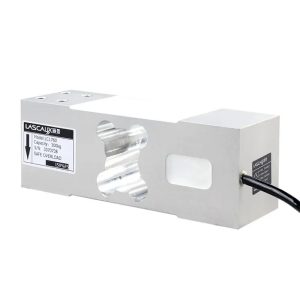
LC1760 Single Point Load Cell for Low Capacity Hopper Scales
Researchers arrange these strain gauges in a Wheatstone bridge configuration. When the load cell bends from weight, some gauges detect tension, and others detect compression. This causes a change in electrical resistance. Then, it gets converted into a voltage signal that matches the applied load.
The unique structure of a single point load cell directs the force in a controlled way. Cut-outs or thin sections help keep the deformation pattern steady, no matter where the load is placed. This is the result of precise engineering aimed at achieving uniform strain distribution.
The Theory Behind Off-Center Loading
From a theoretical view, a load cell is a mechanical system. It changes force into strain. In traditional beam-type load cells, the location of the applied force greatly affects the output. A single point load cell handles bending moments from off-center loads.
Structural symmetry and strategic placement of strain gauges achieve this. The load cell body usually has a parallelogram shape. This design keeps the measuring section safe from outside disturbances. When someone applies a load off-center, it generates both a vertical force and a torque. The geometry ensures that the torque component either has little effect on the strain at the gauge locations or balances out.
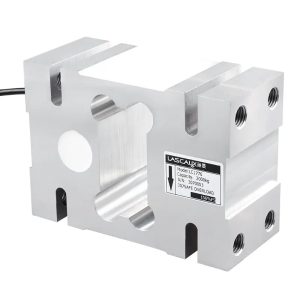
LC1776 Aluminum Alloy Single Point LoadCell for Large Platform Scales
The load cell removes the impact of uneven load placement. This way, the output signal reflects the total weight, not where it’s placed.
From an engineering view, this means looking at bending moments, shear forces, and how stress is spread. Engineers use finite element analysis (FEA) to see how a load cell reacts to various loads. The goal is to reduce errors from eccentric loading. We also want to keep sensitivity and linearity.
Design Considerations
Designing a single point load cell involves balancing sensitivity, durability, and cost. Key factors include:
Material Selection Aluminum is often chosen for low-capacity load cells. It’s lightweight and has good elasticity.
For higher capacities or harsher environments, alloy steel or stainless steel may be preferred. The material must exhibit stable elastic properties and minimal hysteresis.
Geometry and Structure The shape of the load cell is critical. Cut-outs and thin sections concentrate strain in specific regions. These are the areas where we place strain gauges. The structure must also keep off-center loads from causing big measurement errors.
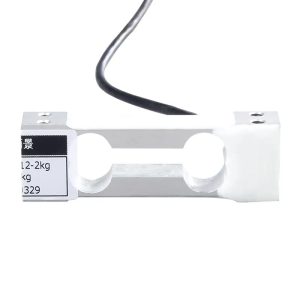 LC7012 Single Point Load Cell for Jewelry Scales
The placement of strain gauges is determined with precision. They are placed where the strain best shows the applied load. This position is least influenced by external factors like torque or side forces. The Wheatstone bridge configuration enhances signal output and provides temperature compensation.
Single point load cells are usually made for certain platform sizes. For example, a load cell intended for a 400 mm × 400 mm platform may not perform accurately on a larger platform. Matching the load cell capacity to the platform dimensions is essential for maintaining accuracy.
Load cells face moisture, dust, and temperature changes in real-world use. Sealing properly, like using IP-rated enclosures, is key for stable performance. Temperature compensation techniques are also essential.
Application in Platform Scales
The most common application of single point load cells is in platform scales. These are widely used in retail, logistics, food processing, and laboratory environments. The main benefit is that users don’t have to place items exactly at the center of the scale. This makes things faster and cuts down on mistakes.
In a typical platform scale, the mounting kit lets the load cell move a bit under the platform. The platform needs to have sufficient strength to distribute the load evenly. It should also transmit force with efficiency to the load cell.
The single point design keeps the scale accurate, even with uneven loads. This is common in real-world use.
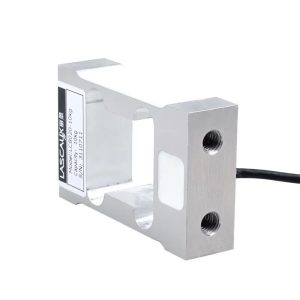
LC8020 Aluminum Single Point Load Cell -Retail/Electronic Scales
Other Use Cases
Single point load cells are also used in:
-
Bench scales – for laboratory and industrial applications
-
Counting scales – where accurate weight measurement is used to count items
-
Packaging machines – where products may not always be perfectly aligned
-
Medical devices – such as patient or infant scales
-
Kitchen and consumer scales – compact and cost-effective solutions for everyday use
Practical Observations
Single point load cells offer a solid mix of performance and practicality for real-world use. While they may not offer the highest precision compared to multi-load-cell systems, they are sufficiently accurate for many uses.
It is important to note that although these load cells can handle off-center loads, there are limits. Extremely uneven loading or loads exceeding the rated capacity can introduce errors or cause damage. Proper installation and adherence to specifications are essential.
Calibration is another important factor. A well-designed load cell is important, but system accuracy also needs good calibration. This includes the load cell, electronics, and mechanical setup.
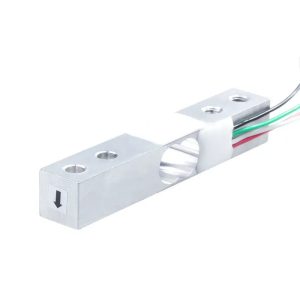
8013 Single Point Load Cell for Retail Scales
The single point load cell demonstrates how clever design simplifies user interaction. It maintains strong functionality, too. Solving off-center loading makes weighing systems user-friendly, reliable, and efficient.
Every part of the single point load cell is designed for reliable daily performance. Its strain gauge setup and shape work together to ensure accuracy. This solution is popular in supermarkets. It is also practical in industrial settings. It works well for modern weighing technology.